Greyhound News |
7
“When considering careers whilst at
Kearsney, I was drawn to Medicine as I
could see the huge unmet need in South
Africa. Whilst at med school, this was
refined further as it became clear that the
need was greatest in rural areas. Thus I set
about gathering rural skills like anaesthetics,
general surgery, plastic surgery, obstetrics,
administration and aviation!
“I moved my family north to practice as a
rural doctor at KZN’s Bethesda Hospital,
where I became the medical superintendent.
There, I stumbled upon the blind people
of Maputoland (UMkhanyakude district)
and, with encouragement from a mentor,
decided to train in Ophthalmology.
“Having set up an Ophthalmology unit
there and satellite eye units at neighbouring
hospitals in that district, my attention was
drawn north again. Neighbouring Swaziland
had no eye services whatsoever. The
Good Shepherd Hospital welcomed me
to commence an eye service through the
mission organisation CBM, which provided
the means.”
Jonathan established the clinic in 1998
in a side room with minimal equipment.
Cataract surgery was done in the hospital’s
minor theatre and, since there were no
beds allocated for eye patients, they slept on
floor-beds.
He realised cataract blindness in Swaziland
was common, yet those afflicted were
unaware of, or unable to access, the new
service. A strong community outreach
programme was the only solution.
Being the only Ophthalmologist, the clinic
soon became very busy with Jonathan
performing up to 30 cataract surgeries
on some days. And so training became a
priority.
In 2002 the eye ward opened, the clinic
moved to larger premises and a small
operating theatre developed - all in a
building designed and built to be a maternity
wing! Two years later Jonathan moved into a
new theatre block adjacent to the ward; and
the clinic relocated to larger rooms, where
it remains today.
“Budget restraints and the financial crisis in
Swaziland allow us only two eye-care nurses
and three general nurses. Out of necessity
we’ve had to improve efficiency, thus we run
a dual theatre with the microscope between
two beds. This way, we perform surgery on
two patients at a time. It has almost tripled
our productivity,” he says.
The eye clinic has a policy of helping
everyone visiting the department on the
same day.
“The cost for surgery is R600, but we don’t
turn anyone away, either for lack of money
or if we are already very busy. We have
three clinic days and two operating days
a week and, as a rule, we have no waiting
lists and arrange sponsorship for surgery as
needed,” he says.
Now, with the levels of cataract blindness in
Mozambique being so enormous, Jonathan
sees the north calling again!
“This developing nation has the will, but little
ability, to develop its services to the rural
and impoverished communities outside of
Maputo. Already our eye service is enabling
Mozambiquans to seek help at Good
Shepherd, since the hospital is only 120km
from Maputo. Participating in cataract
surgical missions to remote Mozambique
communities will certainly be part of my
next five year plan. That, and becoming
fluent in Portugese.”
Jonathan is equally passionate about
providing encouragement and training.
Some of his former trainees are now
working in Cameroon, Madagascar, the
Eastern Cape and Cape Town.
“There are inadequate numbers of
Ophthalmologists trained for public health.
The set of skills required are difficult to
attain, yet we have the conditions to provide
that training. I really love inspiring young
doctors to look for unusual solutions to
provide health to whole populations. And
we’ve proved that it can be done.
“Many doctors, mostly South Africans, join
me for six month attachments and earn the
Diploma in Ophthalmology. Two are already
planning to come in 2016. Then there are
the 40 or more medical students who come
annually from places like Kuala Lumpur,
Liege, Edinburgh and Stellenbosch. They
spend about a month with me and I see it
as an amazing opportunity to educate them
in rural health. I believe this calling to train
and hopefully inspire other medics won’t go
away, but will only grow.
“Just as I was inspired, it’s a joy for me and
my family to take in school-aged youngsters
and let them in turn be inspired by what
they see here in Swaziland. Many Kearsney
boys have had that opportunity and I hope
many more will follow. Some are already
qualified as doctors or still studying.
“So it’s with great expectation that I’m
waiting for their stories to come out, then I
can put away my Surgeon’s knives!”
NOTABLE ALUMNI
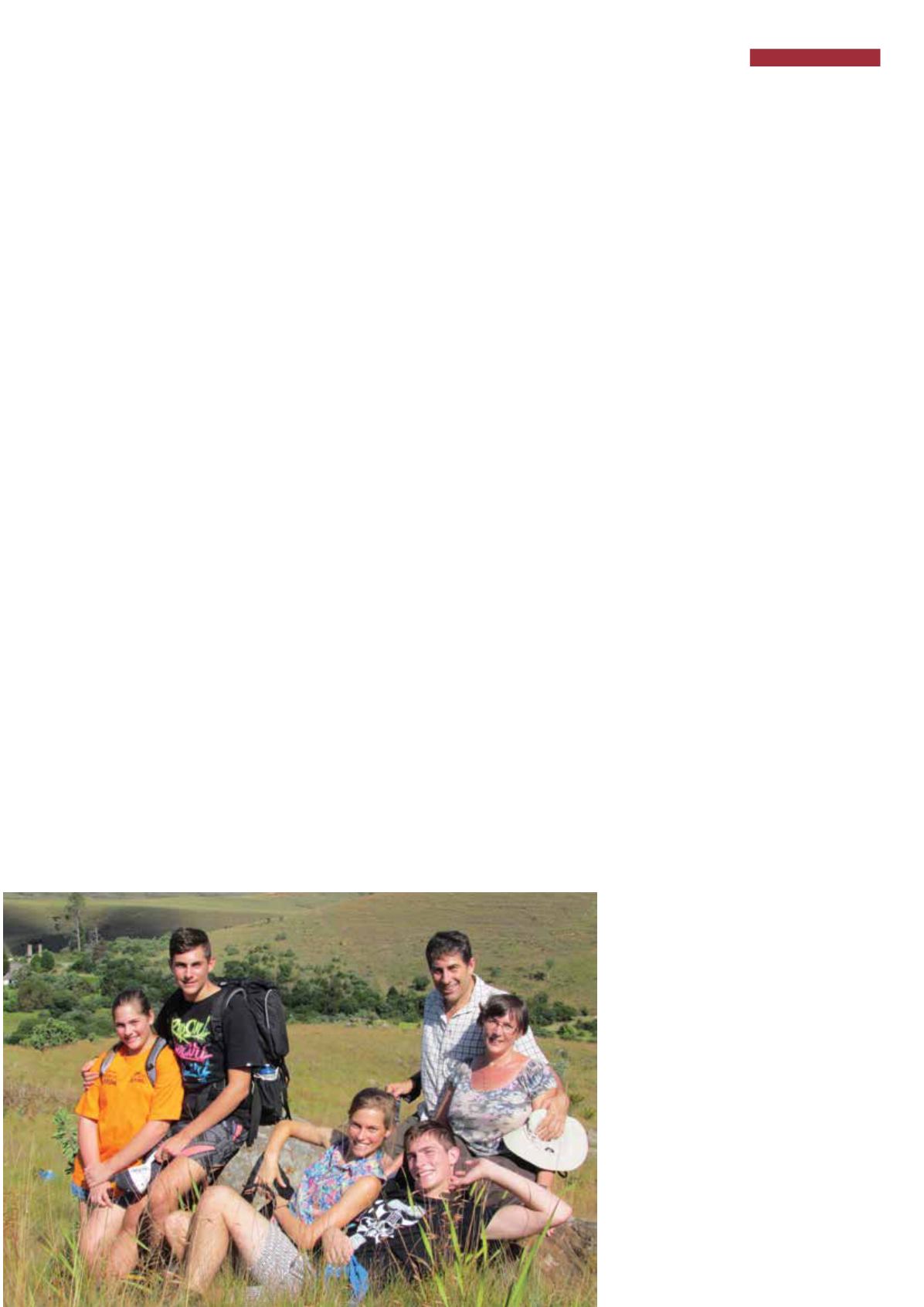
The Pons family.
(L to R) Ruth,
Daniel
(KCOB 2014),
Emma,
Timothy
(KCOB 2012) with
parents
Jonathan
and Helen.


